
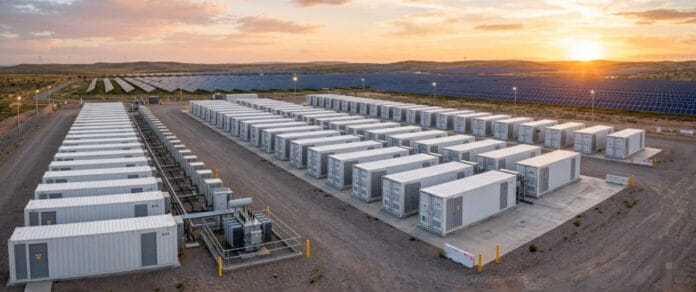
If you manufacture, install, or invest in battery storage, UL certification for BESS is the first real safety and compliance milestone your product must clear. Battery Energy Storage Systems (BESS) range enormously — from a 300 Wh portable power station in a camper van to a 5 MWh containerized system feeding the grid — and because the risks differ so widely between those products, no single UL mark covers them all. Instead, manufacturers work through a layered stack of standards (cell → module → full unit), applied differently depending on the product category: portable, home, mobile, commercial & industrial, or containerized/utility-scale.
This guide is organized in two parts. Part one covers the certification stack itself — cell certifications, battery module/pack certifications, and full-unit/system certifications, explained in depth. Part two maps exactly which certifications apply to portable BESS, home BESS, mobile BESS, C&I BESS, and containerized BESS, and explains why. Because the process itself matters just as much as the standards, the guide closes with a step-by-step certification walkthrough and a quick-reference table you can bookmark.
Why UL Certification for BESS Matters
Pursuing UL certification for BESS isn’t just a marketing checkbox — it directly affects whether a project gets permitted, insured, and financed. Fire marshals and building departments increasingly require UL-listed equipment before approving installation; insurers use UL listings to underwrite risk, so an uncertified system can be difficult or even impossible to insure. Utilities also require certified inverters and controls before allowing a grid-tied system to interconnect, and lenders treat certification as a baseline signal of reduced risk. Codes such as NFPA 855 explicitly reference UL 9540 and UL 9540A as the basis for compliance, so skipping certification doesn’t just create a safety gap — it risks stalled permits and voided coverage.
Part 1: The UL Certification for BESS Stack (Cell, Module, System)
Manufacturers build almost every BESS product from the same three layers, so UL certification for BESS generally follows the same structure regardless of size: Cell → Module/Pack → Full Unit/System.
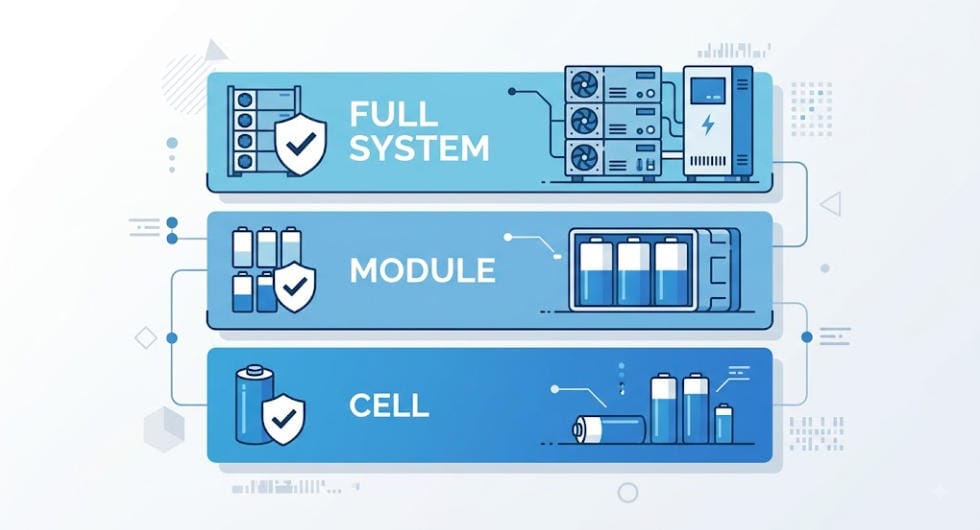
Layer 1: Cell-Level Certifications
The cell is the fundamental energy-storing unit — for example, an 18650, 21700, or prismatic lithium cell. Cell certifications test this raw electrochemical component in isolation, before manufacturers wire it into a pack.
| Standard | Full Name | What It Tests |
|---|---|---|
| UL 1642 | Standard for Lithium Batteries | Short circuit, crush, shock, heating, forced discharge, and projectile/fire risk at the individual cell level |
| IEC 62133-1 / -2 | Safety requirements for portable sealed secondary cells | International equivalent/complement to UL 1642, widely required for global market access |
| UN 38.3 | UN Manual of Tests and Criteria, Section 38.3 | Mandatory transportation test (altitude, thermal cycling, vibration, shock, short circuit, overcharge) for shipping lithium cells |
| IEC 62619 | Safety requirements for industrial secondary lithium cells/batteries | Increasingly required for stationary/industrial cells; includes functional safety of the control system |
Cell certification matters because a cell that hasn’t passed UN 38.3 cannot legally ship internationally, and a cell lacking UL 1642 or IEC 62133 certification lacks validated protection against basic abuse. Getting this layer right lays the foundation everything else in UL certification for BESS builds on.
Layer 2: Battery Module / Pack Certifications
Once manufacturers assemble cells into a module or pack — adding a Battery Management System (BMS), wiring, fusing, and an enclosure — a new layer of certification applies.
| Standard | Scope | Typical Application |
|---|---|---|
| UL 1973 | Batteries for stationary, vehicle auxiliary power, and light electric rail (LER) applications | The primary module/pack standard for stationary BESS — home, C&I, and utility-scale battery racks |
| UL 2054 | Household and Commercial Batteries | Battery packs for household/commercial products, broader scope, often used for smaller consumer-adjacent packs |
| UL 62368-1 | Audio/Video, IT & Communication Technology Equipment Safety | Frequently invoked for electronics, USB/AC output stages, and control boards, especially in portable products |
Module certification matters because this is where testing validates the Battery Management System’s ability to detect and respond to overcharge, over-discharge, over-temperature, and cell imbalance. However, a cell-certified product can still fail catastrophically if the BMS or pack-level protections are inadequate — which is exactly the gap UL 1973 closes, and a prerequisite most manufacturers complete before pursuing full UL certification for BESS at the system level.
Layer 3: Full Unit / System Certifications
This layer covers the complete, sellable, installable product — battery plus inverter/PCS, enclosure, controls, and, in larger systems, fire suppression and thermal management — which engineers evaluate as one integrated whole. UL 9540 is the core standard at this layer, and it’s the certification most people mean when they talk about UL certification for BESS at the product level.
| Standard | Scope | Typical Application |
|---|---|---|
| UL 9540 | Energy Storage Systems and Equipment | Core “whole system” certification for stationary ESS of all sizes — residential through utility-scale |
| UL 9540A | Test method for thermal runaway fire propagation | Not a certificate — a fire test producing data for permitting and Hazard Mitigation Analysis (HMA) |
| UL 2743 | Standard for Portable Power Packs | System-level standard for non-stationary, movable, battery-powered products (portable power stations) |
| UL 2056 | Outline of Investigation for Power Banks | System-level standard for small, DC-output-only power banks (phone/laptop chargers) |
| UL 1741 (+SA) | Inverters, converters, controllers for distributed energy resources | Certifies the power conversion system feeding into UL 9540-certified products; SA covers grid-support functions |
| UL 1998 | Software in Programmable Components | Validates safety-critical firmware/software logic (BMS control, protection relays) |
| UL 3703 / 3730 | Control panels and balance-of-system equipment | Applies to switchgear, DC combiner/control panels used alongside larger BESS installations |
Part 2: UL Certification for BESS by Product Category
This is where it gets practical, because the same underlying cell might end up in five very different products. Each product type follows a different certification path since installation context and risk profile differ sharply: a device you carry is regulated differently than a device bolted to your house, which in turn differs from a shipping-container-sized asset on a substation pad.
A. Portable Battery Energy Storage (Portable Power Stations)
Examples: Camping power stations, jobsite power packs, and emergency backup units, typically under about 18 kg or wheeled, with AC/DC/USB outputs.
Primary certifications required:
- UL 2743 — the core system-level standard specifically for portable power packs (electrical, mechanical, and battery-system safety, including booster/jump-start functions)
- UL 1642 / IEC 62133-2 — for the lithium cells inside
- UN 38.3 — mandatory for transport by air, sea, or road
- UL 62368-1 — for the AC output/charger and electronics sections
- UL 2056 — only if the product is a small DC-only power bank rather than a full power station
UL 9540 and UL 9540A generally don’t apply here, because that standard covers stationary, installed ESS only. For example, sellers cannot legally market a product tested only as a “power bank” under UL 2056 as a general-purpose portable power station regulated under UL 2743, and vice versa — scope mismatches like this cause many certification failures in this category. In short, UL certification for BESS in the portable category almost always means UL 2743, not UL 9540.
B. Home Battery Energy Storage (Residential ESS)
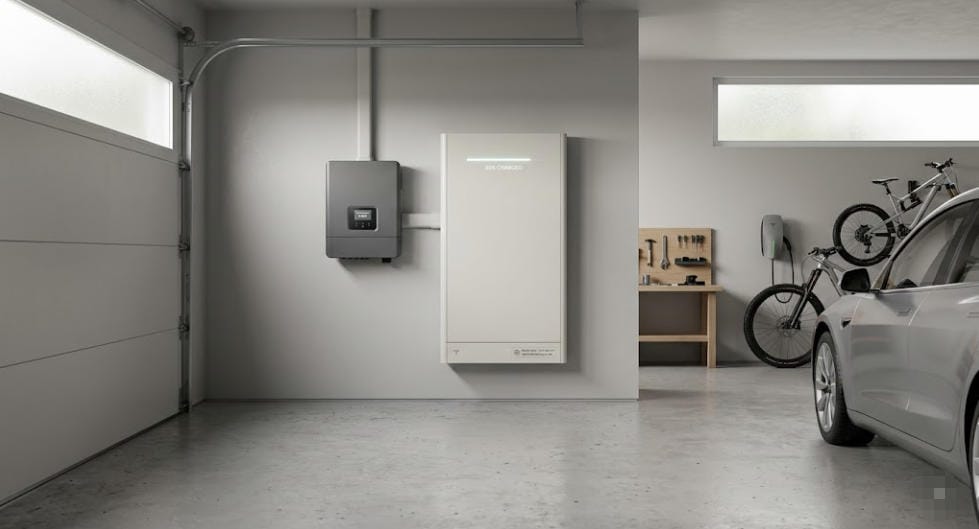
Examples: Wall-mounted or floor-standing home battery systems paired with solar (typically 10–20 kWh), and whole-home backup batteries.
Primary certifications required:
- UL 9540 — the mandatory full-system certification for residential ESS in virtually every U.S./Canadian jurisdiction with modern fire code adoption
- UL 1973 — for the underlying battery module/pack
- UL 1741 (with SA) — for the inverter, especially where the system interconnects with the grid
- UL 9540A — many jurisdictions require it once capacity exceeds the default residential threshold (commonly cited around 20 kWh per unit)
- UL 1998 — for BMS/control firmware
- NFPA 855 — installation code governing spacing, indoor/outdoor placement, and separation distances
Because most fire codes now explicitly cover residential ESS, and homes are occupied structures with life-safety stakes, achieving UL certification for BESS here is the most heavily regulated path among the “small” BESS categories.
C. Mobile Battery Energy Storage
Examples: Trailer-mounted or vehicle-mounted battery systems used for event power, film/TV production, construction sites, disaster relief, or EV charging support.
Primary certifications required:
- UL 2743 (with enhanced mechanical/vibration testing) — where the product remains within portable-power-pack scope
- UL 9540 — where the mobile asset is large enough, or used repeatedly in a semi-fixed capacity, that it functions more like a relocatable stationary ESS
- UL 1973 — for the battery pack/rack itself
- UL 458 — Power Converters/Inverters for Land Vehicles and Marine Craft, relevant when the inverter is vehicle- or trailer-integrated
- UN 38.3 — for cell transport compliance
- DOT/FMCSA vehicle regulations — not UL, but relevant if permanently mounted to a registered trailer or vehicle chassis
Mobile BESS is the trickiest category because it sits in a gray zone between “portable” and “stationary.” The classification typically depends on weight and size, whether the unit has wheels versus needs a vehicle to move, how long it dwells in one location, and whether it ever interconnects with the grid. Consequently, AHJs increasingly request UL 9540-equivalent documentation for any mobile unit above a few dozen kWh, even though it isn’t permanently fixed to a foundation. Confirming classification early keeps UL certification for BESS on schedule for mobile deployments.
D. Commercial & Industrial (C&I) Battery Energy Storage
Examples: Behind-the-meter storage for factories, warehouses, data centers, retail sites, and campuses, typically 50 kWh to several MWh, often paired with solar for demand charge management and peak shaving.
Primary certifications required:
- UL 9540 — mandatory full-system certification; C&I systems fall explicitly within its non-residential scope
- UL 1973 — for battery racks/modules
- UL 9540A — C&I systems almost always need it at this scale, since they routinely exceed the non-residential default capacity threshold (commonly cited around 50 kWh)
- UL 1741 (SA) — for grid interconnection, especially where the system participates in demand response or exports power
- UL 1998 — for the Energy Management System (EMS) and BMS software
- NFPA 855 — governs indoor/outdoor placement, fire-rated separation, spacing between units, and ventilation
C&I systems are large enough to pose meaningful fire and business-continuity risk, yet owners usually install them at commercial sites such as parking structures, rooftops, or mechanical rooms rather than purpose-built utility substations. For this reason, UL 9540A data carries significant weight before local authorities issue a permit — which underscores why UL certification for BESS leans so heavily on fire-propagation evidence at this scale.
E. Containerized Battery Energy Storage (Utility-Scale / Grid-Scale)
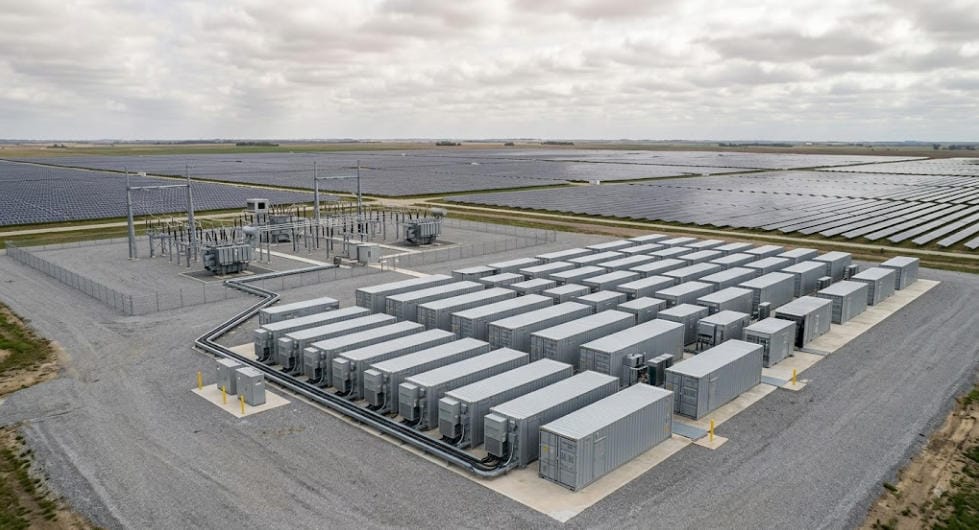
Examples: Standard 20 ft or 40 ft ISO-container-format BESS units, ranging from roughly 1–5+ MWh each, deployed in arrays for grid services such as frequency regulation, capacity, renewable smoothing, and transmission/distribution deferral. At this scale, UL certification for BESS becomes the most demanding of any category.
Primary certifications required:
- UL 9540 — mandatory system certification, typically evaluated for the container as a complete integrated product
- UL 9540A — large-scale fire propagation testing is essentially universal at this scale; labs often test at the “unit” and “installation” (multi-container array) level
- UL 1973 — for the battery racks inside the container
- UL 1741 (SA) — for grid-interconnected inverters/PCS, plus compliance with IEEE 1547 for interconnection performance
- UL 3703 / UL 3730 — for DC combiner panels, switchgear, and balance-of-system control panels
- UL 1998 — for the Energy Management System and safety-critical control logic
- IEC 62619 / IEC 62933 — frequently required in parallel for projects with international components or export markets
- NFPA 855 / NFPA 68 / NFPA 69 — govern container spacing, explosion venting, and deflagration protection
- UN 38.3 / UN 3480 — transport and shipping compliance for the cells/modules before container assembly
Containerized systems combine the highest total energy content with proximity to other high-value equipment — substations, transformers, adjacent containers — and often sit near communities or critical infrastructure. Therefore, full-scale UL 9540A propagation testing, explosion venting analysis, and NFPA 855 site design become essentially non-negotiable for permitting and insurance.
Part 3: UL Certification for BESS Quick-Reference Table
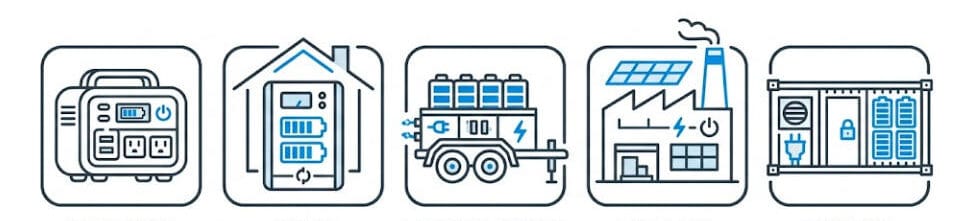
The table below summarizes UL certification for BESS requirements across all five deployment categories, so you can see the full picture at a glance.
| Category | Cell | Module/Pack | Full System | Fire Propagation | Inverter/Grid |
|---|---|---|---|---|---|
| Portable BESS | UL 1642 / IEC 62133-2 | UL 62368-1 | UL 2743 | N/A | N/A |
| Home BESS | UL 1642 / IEC 62133-2 | UL 1973 | UL 9540 | UL 9540A (often req.) | UL 1741 (SA) |
| Mobile BESS | UL 1642 / IEC 62133-2, UN 38.3 | UL 1973 | UL 2743 or UL 9540 | UL 9540A if applicable | UL 458 or UL 1741 |
| C&I BESS | UL 1642 / IEC 62133-2 | UL 1973 | UL 9540 | UL 9540A (typical) | UL 1741 (SA) |
| Containerized/Utility | UL 1642 / IEC 62133-2, UN 38.3/3480 | UL 1973 | UL 9540 | UL 9540A (near-universal) | UL 1741 (SA), IEEE 1547 |
Part 4: The UL Certification for BESS Process, Step by Step
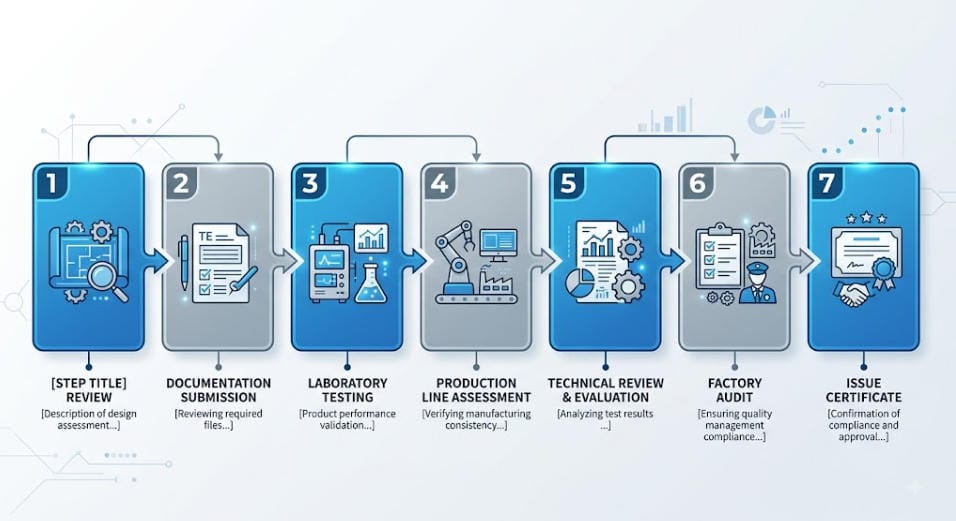
Whether you’re pursuing UL certification for BESS as a portable-device manufacturer or a utility-scale integrator, the journey follows a similar arc. Testing labs may be UL Solutions itself, or another accredited Nationally Recognized Testing Laboratory (NRTL) such as Intertek/ETL, TÜV, or CSA operating under recognized accreditation.
- 1. Standard selection — identify which layer(s) apply and which product-category standard governs the full system (UL 2743 versus UL 9540, for example)
- 2. Design documentation review — submit schematics, BOM, BMS logic, enclosure drawings, and safety documentation
- 3. Sample submission — ship production-intent samples (cells, modules, or complete units) to the lab
- 4. Laboratory testing — electrical abuse, mechanical abuse, environmental testing, and, where applicable, full-scale fire propagation testing
- 5. Factory inspection — an initial audit confirms production matches what was tested, supporting ongoing Follow-Up Service
- 6. Certification issuance — UL issues a Listing or Recognition mark; UL 9540A instead produces a data report rather than a pass/fail mark
- 7. Follow-up services — periodic unannounced factory audits and re-verification follow any design change
Because timelines vary by scope, plan accordingly: labs can often certify simple portable products (UL 2743/2056) in a few months, while full UL 9540 system certification — especially with UL 9540A large-scale fire testing for C&I or containerized products — commonly takes 6–12+ months. For that reason, start the process well ahead of any permitting deadline.
Part 5: Key Takeaways on UL Certification for BESS
The following points summarize what matters most when pursuing UL certification for BESS across any product category:
- Match the standard to the product’s actual use case, not just its battery chemistry — installation context drives the risk profile, not the cell
- Get an early classification conversation with the AHJ for mobile BESS, since it’s the category most likely to fall into ambiguous territory
- Expect UL 9540A to become non-negotiable as scale increases — home systems can sometimes avoid it below capacity thresholds, but C&I and containerized systems almost never do
- Build up the stack instead of skipping layers — starting with UN 38.3/UL 1642-certified cells and UL 1973-certified modules de-risks and speeds up full UL 9540 system certification
- Treat certification as an ongoing compliance program, not a one-time badge — factory follow-up audits and design-change reviews apply across every category
In short, UL certification for BESS is never a one-time event — it’s an ongoing compliance program. This guide covers general information only; standards, thresholds, and jurisdictional requirements change and vary by location, so always confirm current requirements directly with UL Solutions (or your chosen NRTL) and your local Authority Having Jurisdiction before finalizing a certification plan.