
As photovoltaic (PV) technology continues to evolve, solar module manufacturers are facing new challenges beyond improving cell efficiency. Advanced cell technologies such as TOPCon, HJT, BC (Back Contact), and perovskite tandem cells require higher levels of protection, reliability, and long-term performance.
The encapsulation film, although invisible inside the module structure, plays a critical role in determining module lifetime, power retention, and resistance against environmental stresses such as moisture, UV radiation, thermal cycling, and potential-induced degradation (PID).
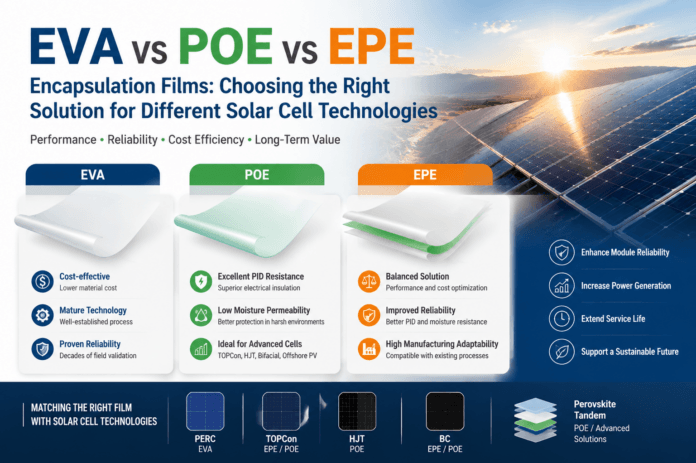
Among all encapsulation solutions, EVA, POE, and EPE films remain the three most widely adopted materials. However, each material has different characteristics, making them suitable for different solar cell technologies and application scenarios.
Choosing the right encapsulation film is no longer simply a cost decision—it has become a strategic choice directly related to module reliability and energy yield.
EVA Encapsulation Film: The Most Mature and Cost-Effective Solution
EVA solar film has been the dominant encapsulation material in photovoltaic modules for more than 40 years. Its long-term success comes from a combination of balanced performance, manufacturing maturity, and cost advantages.
Key Advantages of EVA Film
1. Excellent Manufacturing Compatibility
EVA has a well-established supply chain and is compatible with mainstream module production processes. Manufacturers worldwide have extensive experience with EVA lamination parameters, reducing production risks and improving manufacturing efficiency.
2. Strong Optical Performance
High-transparency EVA films allow efficient sunlight transmission into solar cells, helping maximize module power output.
3. Cost Advantage
Compared with other encapsulation materials, EVA offers a lower material cost, making it highly competitive for large-scale PV projects where reducing system costs remains a priority.
4. Proven Long-Term Reliability
Decades of field experience have demonstrated EVA’s ability to maintain module durability under various climates, including residential, commercial, and utility-scale applications.
Limitations of EVA
Despite its advantages, EVA also has certain limitations.
During long-term operation, EVA may generate acetic acid due to hydrolysis, which can contribute to corrosion risks and PID-related degradation under certain conditions.
For traditional P-type PERC modules, these risks are relatively manageable. However, as newer high-efficiency cells become more sensitive, manufacturers increasingly require advanced encapsulation solutions.
POE Encapsulation Film: The Preferred Choice for High-Reliability Modules
POE solar film has gained significant attention with the rapid growth of N-type solar technologies.
Unlike EVA, POE does not contain vinyl acetate groups and has extremely low moisture permeability, providing enhanced protection for sensitive solar cells.
Key Advantages of POE Film
1. Superior PID Resistance
One of POE’s biggest advantages is its excellent electrical insulation performance.
The extremely low ionic migration capability helps reduce PID risks, making POE highly suitable for high-efficiency N-type cells.
2. Excellent Moisture Barrier Performance
For applications in humid environments such as coastal regions, tropical areas, and offshore PV projects, POE provides stronger protection against moisture-related degradation.
3. Better Compatibility with Advanced Solar Cells
POE is widely used in:
- TOPCon modules
- HJT modules
- High-power bifacial modules
- Offshore PV applications
These technologies demand higher reliability because their electrical structures are more sensitive to environmental factors.
Challenges of POE
The main limitation of POE is its higher cost compared with EVA.
Additionally, POE has different processing characteristics, requiring manufacturers to optimize lamination conditions and production parameters.
For some manufacturers, the performance advantages justify the additional cost, especially for premium modules designed for longer service life.
EPE Encapsulation Film: Balancing Performance and Cost
EPE solar film is a multilayer encapsulation film structure that combines EVA and POE advantages.
Typically, EPE consists of:
- EVA layer
- POE layer
- EVA layer
This hybrid design provides a balance between reliability, processing performance, and cost efficiency.
Why EPE Is Becoming Increasingly Popular
1. Reduced POE Consumption
Pure POE films provide excellent protection but increase module costs.
EPE reduces the amount of expensive POE material while maintaining improved moisture resistance and PID protection compared with conventional EVA.
This makes EPE an attractive solution for manufacturers seeking a balance between performance and cost.
2. Suitable for N-Type Module Development
With the rapid expansion of TOPCon technology, EPE has become one of the preferred solutions for high-volume N-type module production.
It provides:
- Improved PID resistance
- Better moisture protection
- Strong adhesion performance
- Lower material cost compared with full POE structures
3. Better Manufacturing Adaptability
Because EPE includes EVA layers, it maintains better compatibility with existing module manufacturing processes.
This reduces equipment adjustment requirements and allows manufacturers to upgrade product performance without significant production changes.
Matching Encapsulation Films with Different Solar Cell Technologies
1. PERC Solar Cells: EVA Remains the Mainstream Choice
PERC technology has relatively mature reliability requirements.
For many PERC modules, EVA continues to provide the best balance of:
- Cost efficiency
- Optical performance
- Manufacturing stability
- Long-term reliability
EVA remains an ideal solution for cost-sensitive applications.
2. TOPCon Solar Cells: EPE and POE Are Increasingly Preferred
TOPCon has become one of the fastest-growing N-type technologies.
Because TOPCon cells are more sensitive to moisture and electrical degradation, encapsulation requirements are higher.
Recommended solutions:
EPE Film
- Cost-effective
- Improved PID resistance
- Suitable for mass production
POE Film
- Maximum reliability
- Suitable for premium modules and harsh environments
3. HJT Solar Cells: POE Provides Better Protection
Heterojunction (HJT) technology uses temperature-sensitive structures and requires excellent moisture resistance.
POE is widely considered one of the best choices for HJT modules because of:
- Low water vapor transmission rate
- High electrical insulation
- Excellent long-term stability
4. BC Solar Cells: Reliability Becomes Critical
Back Contact (BC) technologies are designed for higher efficiency but require advanced encapsulation solutions.
Since BC modules pursue maximum power output over long lifetimes, manufacturers increasingly focus on:
- UV resistance
- PID prevention
- Interface stability
EPE and POE are becoming important choices for BC applications.
5. Perovskite Tandem Solar Cells: Future Materials Demand Higher Performance
Emerging perovskite tandem technologies introduce new challenges, including sensitivity to:
- Moisture
- Oxygen
- Temperature
- Chemical interactions
Future encapsulation materials will require:
- Ultra-low moisture permeability
- High optical transparency
- Chemical stability
- Advanced barrier performance
POE-based and customized multilayer encapsulation solutions are expected to play an important role.
EVA vs POE vs EPE: How Should Manufacturers Choose?
| Feature | EVA | POE | EPE |
| Cost | ★★★★★ | ★★★ | ★★★★ |
| Manufacturing maturity | ★★★★★ | ★★★★ | ★★★★ |
| PID resistance | ★★★ | ★★★★★ | ★★★★ |
| Moisture resistance | ★★★ | ★★★★★ | ★★★★ |
| HJT compatibility | ★★★ | ★★★★★ | ★★★★ |
| TOPCon compatibility | ★★★★ | ★★★★★ | ★★★★★ |
| Large-scale adoption | ★★★★★ | ★★★★ | ★★★★★ |
Conclusion
There is no single “best” encapsulation film for every solar module.
EVA remains highly competitive because of its unmatched cost advantage and manufacturing maturity.
POE represents the premium solution for high-efficiency modules requiring maximum reliability, especially HJT and advanced N-type technologies.
EPE provides a practical middle path by combining EVA’s process advantages with POE’s reliability benefits, making it increasingly attractive for TOPCon and next-generation PV applications.
The future PV market will not be dominated by one encapsulation material, but by customized solutions optimized for different cell technologies and operating environments.